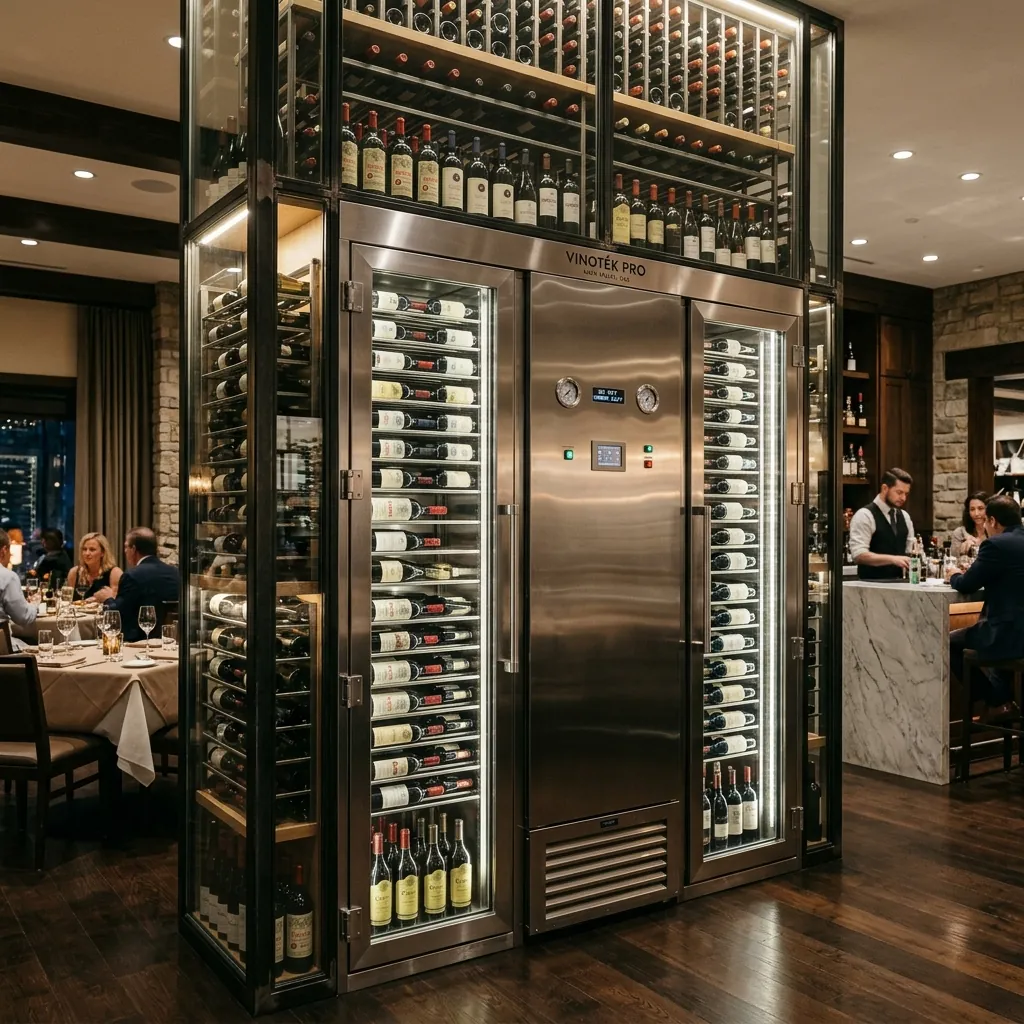
High-rise luxury wine cellars demand more than standard cooling—they require precision-engineered climate control that accounts for altitude, exposure, structural movement, and the elevated expectations of premium collections. VA Wine Cooling designs sophisticated systems that protect every bottle while complementing the architecture and lifestyle of modern luxury residences.
Book a ConsultationDesigning a luxury wine cellar in a high-rise residence is fundamentally different from building one in a traditional home, estate basement, or ground-level entertainment space. In a tower environment, the cellar is influenced by factors that can quietly undermine long-term wine preservation if they are not addressed from the outset: changing exterior temperatures at elevation, solar heat gain through expansive glass, pressure differences created by building systems, vibration from neighboring mechanical equipment, and the limited ability to vent heat in the same way a standalone home can. For collectors who expect their cellar to function as both a preservation environment and a visual centerpiece, the challenge is not simply to make the room cold enough—it is to maintain a stable, controlled microclimate that protects cork integrity, label condition, liquid maturation, and the overall investment value of the collection. VA Wine Cooling specializes in these complex conditions, bringing a design-first approach that aligns engineering, architecture, and conservation into one seamless solution. The result is a climate control strategy that supports the cellar’s aesthetic goals while delivering the stability that fine wine demands over years and decades.
Luxury wine collections thrive in environments where temperature fluctuations are minimized and carefully managed. In a high-rise cellar, the cooling system must do more than simply reach a target temperature; it must hold that temperature consistently despite changing loads, glass exposure, occupancy, and the thermal behavior of the building itself. Precision stability helps preserve the wine’s structure, aromatic development, and aging potential.
Proper humidity control is essential in luxury wine storage because it protects corks from drying out, reduces label deterioration, and helps maintain the overall condition of bottles over time. In high-rise settings, humidity can be especially difficult to maintain due to dry conditioned air, envelope leakage, and the interaction between the cellar and the surrounding HVAC environment. A well-designed system keeps moisture levels in the ideal range without introducing excess condensation risk.
High-rise luxury homes are often designed around serenity, privacy, and refined acoustics, which means the wine cellar cooling system must operate discreetly. Excess vibration can disturb sediment in aged wines, while excessive noise can diminish the experience of a beautifully integrated cellar. VA Wine Cooling prioritizes low-vibration components, remote equipment placement, and sound-conscious design to preserve both the wine and the living environment.
A high-rise wine cellar is as much a design statement as it is a storage environment. Cooling equipment, ducting, insulation, and controls must be integrated in a way that supports the room’s visual intent without compromising performance. Whether the cellar features glass walls, custom millwork, floating displays, or museum-style presentation, the climate system must be invisible where possible and elegant where necessary.
High-rise luxury wine cellars present a unique engineering problem because the room exists inside a building that is already managing its own complex climate demands. Unlike a basement cellar in a detached residence, a tower-level wine room is influenced by the surrounding HVAC infrastructure, the building envelope, and the thermal behavior of adjacent units, corridors, and mechanical shafts. This means the cooling design must be developed with a deep understanding of heat load, insulation performance, vapor management, and the way air moves through the space. A successful system begins with a detailed assessment of the cellar’s dimensions, materials, glazing, exposure, and intended bottle capacity. Every square foot matters, and every design choice affects the stability of the final environment. VA Wine Cooling approaches each project with the expectation that the cellar must perform flawlessly not only on day one, but across the long service life of the collection.
One of the most important considerations in a high-rise environment is the building envelope. Floor-to-ceiling glass, decorative stone, metal framing, and architectural openings can create significant thermal challenges. Sunlight and exterior heat gain may be amplified at elevation, while the surrounding interior spaces may be maintained at temperatures that differ dramatically from the cellar’s target conditions. The cooling strategy must account for these realities through proper insulation, vapor barriers, sealed construction, and equipment sizing that reflects actual load rather than optimistic assumptions. In many cases, the most elegant-looking cellar is also the most technically demanding, because transparency and openness must be balanced against the need to create a tightly controlled storage chamber. This is where technical design becomes indispensable: a beautiful wine room is only truly luxurious when it protects the collection with the same care that it displays it.
Another major factor in high-rise climate control is the difficulty of rejecting heat. Traditional self-contained systems can be limited by the absence of a suitable venting path, especially in condominium towers or mixed-use buildings with strict mechanical restrictions. If heat cannot be moved efficiently away from the cellar, the system will work harder, run longer, and potentially compromise both efficiency and reliability. For this reason, remote condensing solutions, ducted heat rejection strategies, and carefully planned mechanical routing are often essential. The goal is to separate the cellar’s sensitive interior environment from the equipment that serves it, allowing the room to remain quiet, clean, and visually refined while the mechanical burden is handled elsewhere. In luxury applications, this separation is not merely convenient—it is fundamental to preserving the design integrity of the space.
Humidity is equally critical, though it is often underestimated by property owners who focus primarily on temperature. In a high-rise home, conditioned air can be exceptionally dry, and the mechanical systems serving the residence may strip moisture from the surrounding environment. Without dedicated humidity planning, corks can dry, labels can peel, and the cellar can lose the stable atmospheric conditions that fine wine requires. Proper humidity control is therefore not a luxury add-on but a core component of the system architecture. The challenge is to maintain the ideal range without creating condensation on glass, mold on finishes, or moisture migration into adjacent construction. That balance requires careful material selection, tight sealing, and a climate control system that is designed to work in harmony with the room rather than overpower it.
Noise and vibration are also elevated concerns in high-rise settings, where the cellar may be located near living spaces, entertaining areas, or primary suites. A luxury residence is expected to feel calm, private, and acoustically polished, so the wine cooling equipment must be selected and installed with that standard in mind. Compressors, fans, and mechanical vibrations should be isolated, buffered, and, wherever possible, relocated away from the display environment. This not only improves the ambiance of the home but also supports the preservation of the wine itself. Fine wine is sensitive to disturbance, and long-term storage benefits from a stable, low-vibration environment. When the climate system is engineered correctly, the cellar becomes a place of quiet confidence—an environment that works invisibly in the background while the collection matures in peace.
Finally, the high-rise context demands close coordination with architects, designers, builders, and building management. Unlike a detached residence, where the owner may have broader freedom to route equipment and modify structure, a tower project often requires approvals, constraints, and technical documentation. That makes early planning essential. VA Wine Cooling helps ensure that the climate system is integrated into the project timeline before finishes are finalized, so the cellar can be built around the equipment rather than forcing compromises after the fact. This integrated approach reduces risk, protects the investment, and creates a result that feels intentional from every angle. In high-rise luxury wine cellars, the cooling system is not an afterthought—it is part of the architecture of preservation.
Essential Wine Cellar Engineering Resources:
When a wine collection reaches the level of a high-rise luxury cellar, the conversation changes from basic storage to asset protection. Fine wine is not only a pleasure to enjoy; for many collectors it is a curated portfolio of rare vintages, limited releases, and emotionally meaningful bottles that may have been sourced over many years. A failure in climate control can compromise that value quickly and sometimes irreversibly, which is why a premium cellar must be designed with redundancy, reliability, and precision in mind. The ideal system does not merely cool the room to a preset number; it creates the conditions under which wine can evolve gracefully, preserving structure, complexity, and provenance. VA Wine Cooling understands that the true purpose of climate control is to safeguard the collector’s confidence, allowing the cellar to function as a secure environment rather than a source of concern.
To protect collection value, the cooling system must be matched to the cellar’s actual use pattern. A room that is opened frequently for entertaining behaves differently than a private archive accessed only occasionally. A display-forward cellar with extensive glass and lighting generates different loads than a dense storage room lined with compact racking. Even the number of bottles, the type of cork closure, and the frequency of door openings can influence the design. This is why luxury systems are never one-size-fits-all. They are carefully calibrated to the room’s thermal profile, the owner’s lifestyle, and the collection’s long-term preservation needs. The more refined the cellar, the more important it becomes to design the climate system as a custom solution rather than a generic appliance.
In high-rise residences, one of the most common mistakes is underestimating the impact of adjacent interior conditions. The cellar may be surrounded by conditioned living areas, but that does not mean the thermal load is negligible. Kitchens, media rooms, sunlit corridors, mechanical closets, and exterior walls can all introduce heat or instability. A luxury wine cooling solution must be able to respond to these influences without overcycling or creating unwanted temperature swings. This is where advanced controls and properly sized equipment become essential. A stable cellar is one where the system works quietly and predictably, maintaining the desired climate with minimal intervention. The owner should not have to think about the cooling system every day; instead, the system should quietly preserve the value of the collection in the background.
Humidity management also plays a direct role in protecting value because the condition of the bottle exterior often reflects the quality of the storage environment. Labels, capsules, and corks are part of the presentation and provenance of a collection, especially for wines intended for resale or long-term aging. Inadequate humidity can dry out corks, inviting oxidation, while excessive moisture can damage paper labels and create an environment where mold may develop. Luxury climate control must therefore balance preservation with presentation. The goal is a room that feels refined and museum-like, where the bottles are not only safe but also beautifully maintained. This level of care is especially important in high-rise cellars, where the owner may want the space to function as both a private archive and a social centerpiece for tastings and gatherings.
Another essential element is serviceability. A premium system should be designed so that routine maintenance is straightforward and minimally disruptive. In a high-rise luxury home, access to mechanical components may be more limited than in a ground-level residence, so the equipment strategy must anticipate long-term care from the beginning. Remote condensers, accessible controls, and well-planned service routes reduce the likelihood of invasive services later on. This matters because collection protection is not just about initial installation; it is about ensuring that the system remains dependable for years. The best luxury wine cooling solutions are those that combine sophisticated performance with practical maintainability, giving owners peace of mind that their cellar will continue to perform as intended even as the collection grows and evolves.
Ultimately, protecting collection value is about more than temperature and humidity numbers. It is about building a controlled environment that respects the rarity, age, and intent behind every bottle. In a high-rise luxury cellar, the climate system must support a lifestyle of entertaining, collecting, and appreciating wine at the highest level, while quietly preventing the kinds of environmental stress that can degrade a portfolio over time. VA Wine Cooling designs systems that are as thoughtful as the collections they serve, ensuring that each cellar becomes a dependable sanctuary for fine wine and a lasting expression of the owner’s taste and standards.
For many collectors, the cellar is also part of a broader interior narrative. It may sit beside a dining room, overlook a skyline, or anchor a penthouse entertaining suite. In these settings, the cooling system must support not only preservation but also presentation. That means minimizing visible hardware, avoiding intrusive duct runs where possible, and selecting equipment that aligns with the architectural language of the home. A luxury cellar should feel deliberate from the first glance and trustworthy upon closer inspection. When climate control is designed correctly, it enhances the room’s prestige instead of competing with it.
VA Wine Cooling brings a specialized, design-led methodology to high-rise luxury wine cellars because these projects require more than technical competence—they require coordination, discretion, and a deep understanding of how premium spaces are built. The process begins with listening: understanding the client’s collection, the architectural vision, the building constraints, and the expectations for how the cellar should feel when complete. A high-rise wine room may need to serve as a dramatic display, a private archive, a tasting destination, or all three at once. Each of these goals affects the climate strategy, and each must be considered before equipment is selected or finishes are installed. By approaching the project as a complete environment rather than a mechanical problem, VA Wine Cooling helps create cellars that are both beautiful and resilient.
One of the hallmarks of a successful high-rise project is early collaboration. Because tower construction often involves multiple stakeholders, climate control decisions must be aligned with the overall design and construction schedule. This includes evaluating insulation specifications, door selection, glazing performance, vapor sealing, rack layout, lighting loads, and the path for mechanical equipment. If these details are left until late in the process, the project may be forced into compromises that affect both performance and appearance. VA Wine Cooling helps avoid those outcomes by working proactively with the team, identifying potential issues before they become expensive revisions. This kind of foresight is especially valuable in luxury settings, where the cost of rework can be significant and where visual precision matters just as much as technical precision.
The company’s approach also reflects the reality that high-rise cellars must often operate within strict spatial limits. Mechanical rooms may be compact, chase spaces may be narrow, and equipment access can be challenging. A thoughtful design must therefore make the most of every available opportunity without crowding the cellar or compromising the home’s aesthetic flow. That may mean using remote cooling systems, carefully routed ducting, compact control interfaces, or custom solutions tailored to the building’s constraints. The emphasis is always on creating a system that performs efficiently while remaining discreet. Luxury clients do not want to see the machinery of preservation dominate the room; they want to experience the cellar as a calm, refined extension of the home. VA Wine Cooling understands that the mechanical solution should feel invisible in use, even though it is doing highly sophisticated work behind the scenes.
Another defining element of the VA Wine Cooling approach is precision in system matching. In high-rise environments, oversizing can be just as problematic as undersizing because an oversized system may short cycle, create unstable humidity conditions, or produce unnecessary noise. Undersizing, on the other hand, can leave the cellar unable to recover from door openings, lighting loads, or seasonal changes. The right solution requires careful calculation and practical experience. VA Wine Cooling evaluates the room’s thermal envelope, expected usage, and long-term goals to determine a system that is appropriately scaled and configured. This attention to detail is what separates a luxury-grade installation from a generic cooling setup. It is also what gives collectors confidence that their cellar is being designed with the same seriousness as the collection itself.
Maintenance and future adaptability are also part of the design philosophy. A high-rise wine cellar may evolve over time as the collection expands, the layout changes, or the owner’s lifestyle shifts. The cooling system should be able to support that evolution without requiring a complete redesign. By planning for accessible service, sensible controls, and robust performance margins, VA Wine Cooling helps ensure that the cellar remains dependable well into the future. This long-view mindset is essential in luxury projects, where the goal is not simply to complete a room but to create a lasting environment of preservation and enjoyment. The best cellars are the ones that continue to perform beautifully long after the installation is complete, supporting both daily use and long-term collection stewardship.
In the end, the VA Wine Cooling approach is about delivering confidence. Confidence that the room will stay stable. Confidence that the equipment will operate quietly and efficiently. Confidence that the design will respect the architecture and elevate the home. And confidence that every bottle in the collection is being protected by a system engineered for the realities of high-rise living. For owners of luxury residences, that confidence is part of what makes a wine cellar truly exceptional. It is not just a room with bottles in it; it is a carefully controlled environment that honors the value, beauty, and legacy of fine wine.
That philosophy extends to every detail, from the first consultation to the final commissioning of the system. A luxury cellar should not feel experimental or improvised. It should feel intentional, calibrated, and complete. VA Wine Cooling’s role is to bring that level of discipline to the project, ensuring that the final result is as dependable as it is impressive. In a high-rise setting, where the margin for error can be slim, that expertise becomes essential. The right climate control design transforms a beautiful room into a truly enduring wine environment.
Climate control is more complicated in a high-rise wine cellar because the room is affected by a combination of architectural, mechanical, and environmental factors that do not usually exist in a standard basement cellar. At elevation, glass exposure can increase solar heat gain, surrounding HVAC systems can create dry air and pressure differences, and building restrictions may limit where heat can be rejected. In addition, high-rise cellars often need to operate quietly and with minimal vibration because they are located near living and entertaining spaces. All of these conditions make it essential to design a custom system rather than relying on a generic wine cooling approach. A properly engineered solution addresses temperature stability, humidity management, noise control, and equipment placement as part of one integrated strategy.
For most luxury wine cellars, the ideal storage environment is typically centered around a stable temperature in the low-to-mid 50s Fahrenheit, with humidity commonly maintained in a balanced range that protects corks without causing excess condensation. The exact target can vary depending on the cellar’s construction, the wine types being stored, and the owner’s preferences, but the most important factor is consistency. Fine wine does not respond well to frequent swings in temperature or moisture. A stable environment helps preserve aging potential, protect labels and capsules, and reduce the risk of cork drying or premature oxidation. In high-rise applications, careful system design is especially important because surrounding conditions can make it harder to maintain those ideal ranges without specialized equipment and proper sealing.
In some cases a self-contained cooling unit may be possible, but high-rise luxury wine cellars often benefit more from remote or custom-engineered solutions. The reason is that tower environments can make heat rejection, noise control, and vibration management more difficult than in a traditional home. A self-contained system may be limited by venting constraints, may introduce more noise into the living space, or may struggle to maintain stable conditions if the room has significant glass or other high-load features. Remote systems allow the mechanical components to be placed away from the cellar, which can improve aesthetics, reduce sound, and make maintenance easier. The best choice depends on the room’s design, building requirements, and performance goals, which is why professional consultation is so important before installation.
Whether you need installation, service, or maintenance — our team is ready to help. Fill out the form below and we'll get back to you within 24 hours.
By submitting this form, you agree to our Privacy Policy. CSLB Lic#1055057
VA Wine Cooling engineers and maintains precision commercial and residential cooling systems across Southern California.