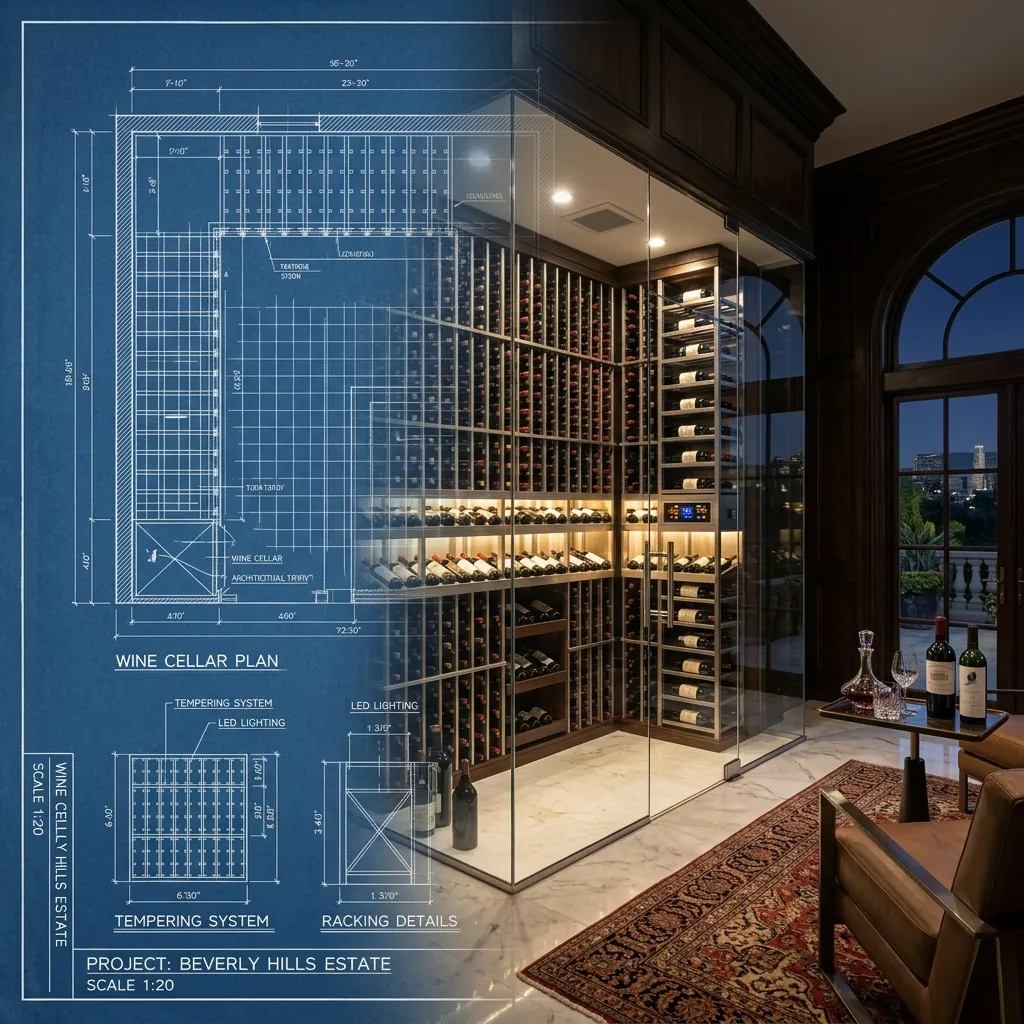
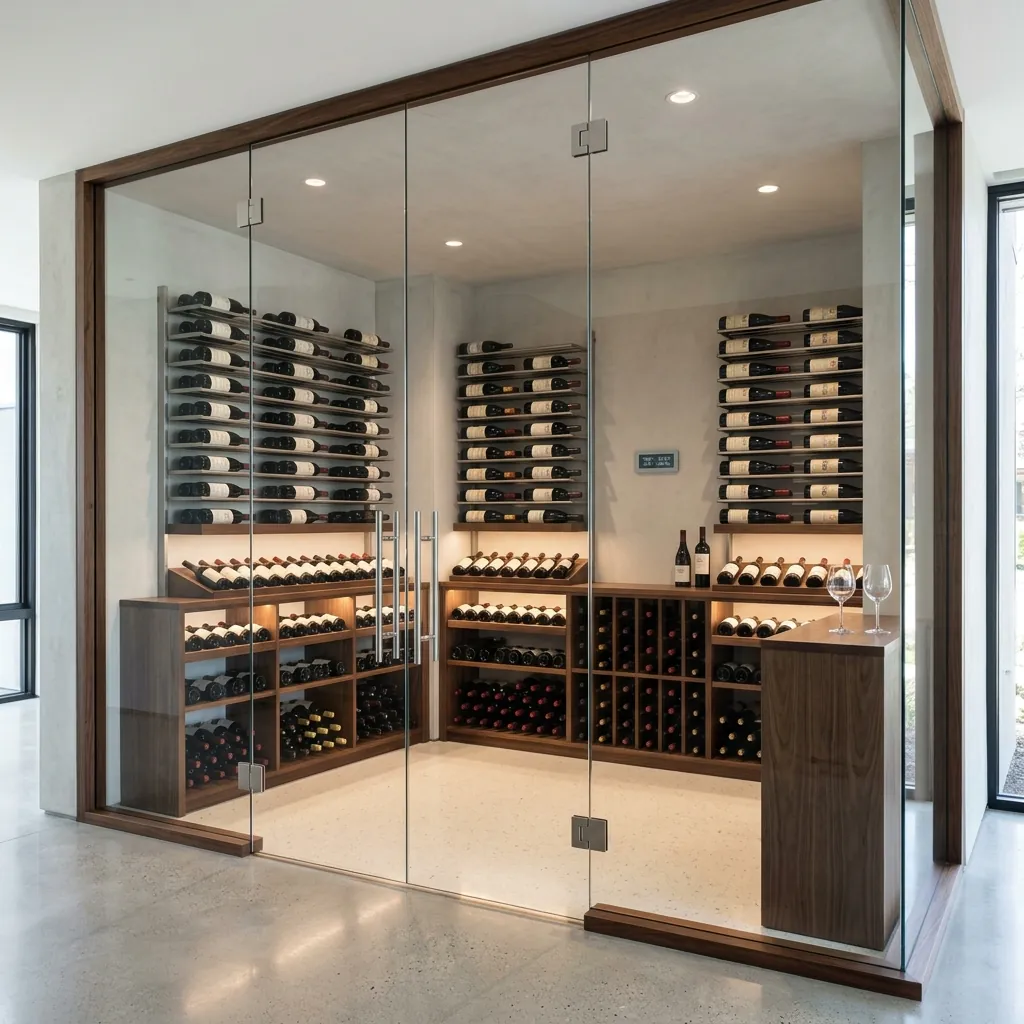
Protect every bottle in your collection with precision wine cellar cooling engineered for scale, stability, and long-term preservation. From boutique private cellars to expansive luxury installations, the right cooling system keeps temperature, humidity, and airflow in perfect balance.
Book a ConsultationOnce a wine collection grows beyond a modest rack or two, the rules of preservation change dramatically. Large collections introduce more thermal mass, more bottle density, more storage zones, and more opportunities for temperature drift, moisture imbalance, and airflow problems. A cellar that performs well for a few dozen bottles can struggle when asked to protect hundreds or thousands of bottles across mixed formats, aging timelines, and storage configurations. That is why wine cellar cooling for large collections requires a deliberate, engineered approach rather than a one-size-fits-all solution. At VA Wine Cooling, we understand that serious collectors need systems designed to safeguard vintages at scale, maintain consistent cellar conditions year-round, and support the long-term value of a collection that may represent years of investment and passion. Proper cooling is not simply about making a room cold; it is about creating an environment where every bottle, whether it is a daily drinker or a rare trophy wine, matures under ideal conditions with minimal fluctuation and maximum reliability.
Large collections require stable, tightly controlled temperatures that minimize fluctuations and protect wine from premature aging, oxidation, and spoilage. Precision cooling systems are designed to hold ideal cellar conditions consistently, even as ambient temperatures change.
Humidity is critical in large cellars because dry air can shrink corks and compromise seals, while excessive moisture can damage labels and encourage mold. Properly balanced systems help preserve both the wine and the presentation value of the collection.
As collections grow, cooling systems must be sized and configured to handle greater volume, more insulation complexity, and varied storage layouts. Scalable design ensures the cellar remains efficient, quiet, and dependable as the collection expands.
The best cooling systems support the slow, graceful evolution of collectible wines by minimizing vibration, heat spikes, and environmental instability. This is especially important for rare bottles intended to age for years or even decades.
Designing wine cellar cooling for large collections begins with understanding that scale changes everything. A small cellar can sometimes tolerate minor inefficiencies because the thermal load is limited and the storage pattern is relatively simple. In a large cellar, however, the room’s physical size, bottle density, insulation performance, lighting, door usage, and surrounding ambient conditions all interact in ways that can either support or undermine preservation. A truly effective design starts with a detailed assessment of the cellar envelope, including wall construction, ceiling and floor insulation, vapor barriers, glass exposure, entry points, and adjacent spaces that may introduce heat. When these factors are ignored, even an expensive cooling unit can struggle to maintain stable conditions, leading to temperature swings that quietly shorten the life of the wines inside.
For collectors with substantial inventories, the cooling strategy must account for how wine is actually stored and accessed. Dense racking systems create thermal pockets if airflow is not planned correctly, and mixed-format storage can introduce uneven cooling demands across different zones. A cellar containing standard Bordeaux bottles, magnums, champagne, and display shelving may require a more nuanced approach than a uniform room of standard racks. The goal is to distribute conditioned air in a way that promotes even temperatures from top to bottom and corner to corner, while avoiding direct drafts that can dry corks or create localized cold spots. This is why professional wine cellar cooling design is less about selecting a machine and more about engineering a preservation environment that works as a whole.
Another essential consideration is heat load. Large collections are often housed in custom rooms with dramatic architecture, glass doors, lighting displays, and adjacent entertainment spaces, all of which can add heat to the environment. The larger the cellar, the more important it becomes to perform a proper load calculation that reflects not just square footage but also insulation quality, ceiling height, bottle volume, occupancy patterns, and external climate conditions. In warm or humid regions, or in homes with variable HVAC performance, the cooling system must be selected with enough capacity to handle peak conditions without running constantly at maximum output. Oversizing can be just as problematic as undersizing if it leads to short cycling and poor humidity control, which is why experienced planning matters so much.
Large collections also benefit from redundancy and serviceability. When a cellar contains a modest number of bottles, a temporary issue may be inconvenient; when it contains a serious investment portfolio of wine, downtime can be costly. For that reason, many high-end installations incorporate system designs that are easier to monitor, maintain, and service over time. This may include accessible equipment placement, remote monitoring capabilities, and a configuration that allows technicians to diagnose issues quickly without disturbing the cellar environment. The most successful large-scale wine cellar cooling systems are those that balance performance with reliability, making it easier for the collector to protect the cellar without constant intervention.
Insulation and vapor management are equally central to design. A large cellar with poor insulation forces the cooling system to work harder, consume more energy, and react more aggressively to external temperature changes. Inconsistent vapor barriers can allow moisture migration that undermines humidity stability and encourages condensation in hidden areas. Over time, these problems can damage cabinetry, racking, labels, and finishes, even if the wine itself remains technically cool. A well-designed large cellar uses insulation and sealing as the first line of defense, allowing the cooling equipment to operate efficiently and maintain a controlled microclimate. In many cases, the most important upgrade is not the cooling unit itself but the quality of the room surrounding it.
Finally, large collection design should always be future-focused. Serious collectors rarely stop at the number of bottles they own today. Acquisition patterns change, rare finds are added, and the cellar may evolve from a storage room into a showcase. The cooling system should therefore be selected with room for growth, flexibility for layout changes, and compatibility with long-term collection goals. A properly engineered cellar is not merely adequate for the present; it is resilient enough to support the collection as it expands, ensuring that the environment remains as refined and dependable as the wines it protects.
Essential Wine Cellar Engineering Resources:
Selecting the right wine cellar cooling system for a large collection is one of the most important decisions a collector can make, because the equipment chosen will determine how well the cellar performs for years to come. Large cellars typically benefit from systems engineered for higher loads, quieter operation, and more precise environmental control. The best choice depends on the cellar’s size, insulation quality, location, and aesthetic priorities, but the core objective remains the same: preserve wine under stable conditions without introducing unnecessary noise, vibration, or environmental instability. A cooling system should feel invisible in daily life while working continuously in the background to protect the bottles that matter most.
One of the first decisions is whether the cellar is best served by a self-contained, split, ducted, or fully custom cooling configuration. Self-contained systems can be appropriate in smaller or simpler spaces, but larger collections often require more sophisticated solutions that separate the noisy mechanical components from the cellar itself. Split systems, for example, can move compressors and condensers away from the cellar, reducing heat and vibration while preserving a clean, elegant interior. Ducted systems can provide a more discreet appearance and more even air distribution, which is especially valuable in large rooms with multiple storage zones or architectural features. Custom configurations may be necessary when the cellar has unusual dimensions, glass exposure, or demanding environmental conditions that standard systems cannot adequately address.
Capacity is another critical factor, but it should never be treated as a simple square-footage calculation. A large cellar with superior insulation may require less cooling power than a smaller room with exposed glass or poor sealing. Likewise, a cellar in a hot climate or one located near a kitchen, mechanical room, or exterior wall may experience a much greater heat load than its dimensions suggest. Professional system selection involves balancing total volume, ambient conditions, insulation performance, and the collector’s desired temperature range. This is why experienced wine cellar cooling providers evaluate the whole environment rather than relying on generic rules of thumb. The wrong capacity can lead to constant strain, inefficient operation, and unstable humidity, all of which can compromise the collection over time.
Noise and vibration deserve special attention in large installations because the very spaces that house extensive collections are often designed for beauty and relaxation. A cellar may adjoin a tasting room, dining area, or showcase hallway, and loud equipment can diminish the experience. More importantly, vibration can subtly disturb sediment in aged wines and create an environment that feels less refined. High-quality cooling systems are designed to minimize these issues through thoughtful component placement, vibration isolation, and smooth operational cycles. For collectors investing in premium wines, these details are not luxuries; they are part of the preservation standard. A cellar should protect the wine without announcing its own presence through constant humming or mechanical turbulence.
Energy efficiency also becomes more relevant as cellar size increases. A large collection may require a cooling system that operates for long periods, especially in warm climates or during seasonal transitions. Efficient systems reduce operating costs while also helping maintain more consistent temperature and humidity levels. When equipment is forced to work too hard, it often becomes less stable, not just less efficient. Energy-conscious design can include well-insulated ductwork, smart controls, properly sized condensate management, and system placement that reduces unnecessary heat gain. Over the life of a large cellar, these efficiencies can translate into meaningful savings and improved reliability.
Controls and monitoring capabilities are increasingly important for collectors who want confidence without constant manual checks. Advanced wine cellar cooling systems may include digital thermostats, humidity monitoring, alarms, and remote access features that allow owners to review cellar conditions at a glance. For large collections, this level of visibility is invaluable because it helps identify issues before they become threats. A slight drift in temperature or humidity can be addressed quickly if the system provides clear feedback. In a serious cellar, monitoring is part of preservation, not an optional extra. The right system should offer both immediate control and long-term peace of mind, ensuring the collection remains protected even when the owner is away.
Ultimately, the best cooling system is the one that matches the cellar’s real-world demands rather than its theoretical dimensions. Large wine collections deserve equipment selected with care, installed with precision, and maintained with consistency. When the system is properly matched to the room, the result is a cellar that performs beautifully, supports wine aging as intended, and preserves the full value of the collection for years to come.
Once a large wine cellar cooling system is installed, the work of preservation shifts from design to long-term stewardship. A collection of significant size is not protected by equipment alone; it is protected by a maintenance culture that treats the cellar as a living environment requiring regular attention. Filters, coils, drains, fans, sensors, and control systems all need periodic inspection to ensure the cooling unit continues operating at peak performance. In a large cellar, even a small maintenance issue can have outsized consequences because the volume of wine at stake is so much greater. Preventive care is therefore one of the most important investments a collector can make, especially when the cellar contains rare vintages, verticals, or bottles intended for long-term aging.
Temperature consistency should be monitored as a routine discipline rather than a reactive measure. Large cellars can develop subtle hot or cold zones if airflow is obstructed by new racking, stored cases, or decorative changes. Over time, these small shifts can create uneven aging conditions across the collection. Monitoring allows the owner or service provider to identify patterns before they become problems, such as a system running longer in summer, a humidity dip during winter, or a section of the cellar that is not receiving adequate circulation. With a large collection, preservation is not about avoiding catastrophic failure alone; it is about maintaining the quiet, steady conditions that support graceful maturation bottle after bottle.
Humidity control is especially important in long-term cellar care because the relationship between air moisture and wine preservation is delicate. Too little humidity can dry corks and increase the risk of oxidation, while too much can lead to mold, mildew, or label degradation. In large cellars, where bottles may remain undisturbed for years, humidity problems can go unnoticed until they affect the collection’s condition or presentation. That is why a cooling system should be paired with a maintenance plan that includes periodic humidity verification, drainage inspection, and assessment of room sealing. If the cellar is located in a region with seasonal swings, the system may need adjustment throughout the year to stay within the ideal preservation range. Long-term success depends on treating humidity as a core performance metric rather than a secondary concern.
Another key aspect of long-term preservation is protecting the cellar from external disruption. Power interruptions, HVAC conflicts, and building changes can all affect a wine room’s environment. Large collections are particularly vulnerable when the cellar is part of a larger estate or commercial-style residence where renovations, occupancy changes, or adjacent mechanical upgrades may alter the heat load. Monitoring systems with alarms or remote alerts can provide early warning if conditions move outside target ranges. In some cases, backup planning may also be appropriate, especially for collections of exceptional value. The more significant the cellar, the more important it becomes to think in terms of resilience, not just day-to-day operation.
Service quality matters as much as equipment quality. Even the best wine cellar cooling system will eventually need professional attention, and a large cellar demands technicians who understand preservation priorities, not just general HVAC performance. Routine service should include cleaning, calibration, inspection of refrigerant levels where applicable, checking airflow patterns, and confirming that the system is cycling properly. A service provider familiar with wine cellars will recognize that a slight temperature variation or humidity inconsistency can matter far more in a cellar than in a typical comfort-cooling environment. That specialized perspective is essential for collectors who want lasting reliability and minimal risk.
It is also wise to think of the cellar as part of a broader collection strategy. Large collections often include wines at different stages of maturity, from newly acquired bottles to prized bottles nearing optimal drinking windows. A well-maintained cooling system supports not only storage but also collection planning, allowing the owner to organize wines by aging potential, region, and format with confidence. When the cellar environment is stable, inventory management becomes more meaningful because the collector can trust that each bottle is aging according to design. In this sense, cooling is not just a mechanical function; it is the foundation of a disciplined, rewarding collecting experience.
For serious collectors, the ultimate goal is peace of mind. A properly maintained cellar should fade into the background while continuing to do its most important work every day. It should preserve the integrity of the collection, protect labels and corks, reduce the risk of spoilage, and support the enjoyment of wine exactly when it is ready. That level of confidence comes from combining smart design, the right equipment, and attentive long-term care. When all three are in place, a large wine collection can be stored with the same elegance and certainty with which it was assembled.
A large wine cellar should generally be maintained at a stable temperature around 55°F, with only minimal fluctuation. The exact target can vary slightly based on the collection, cellar design, and regional climate, but consistency is more important than chasing a specific number. Large collections are especially vulnerable to temperature swings because more bottles and more storage mass can mask problems until they become significant. The ideal system keeps the room cool enough for long-term aging without overcooling, which can dry corks or create uneven conditions across different parts of the cellar. For best results, temperature should be monitored continuously and adjusted by a cooling system sized for the cellar’s true heat load, not just its square footage.
Yes, humidity control is essential for large wine collections because temperature alone does not protect the integrity of the corks, labels, and overall cellar environment. If humidity is too low, corks can shrink and allow oxygen to enter the bottle, which can age wine prematurely or damage it permanently. If humidity is too high, mold and mildew can develop on labels, racks, and finishes, reducing both the aesthetic and practical value of the cellar. Large cellars often require more deliberate humidity management because their volume, insulation, and airflow patterns can create hidden dry or damp zones. The best wine cellar cooling solutions help balance both temperature and humidity so the cellar remains stable, attractive, and preservation-ready.
A cooling system may be undersized if the cellar struggles to maintain target temperature during hot weather, if the unit runs constantly without achieving stability, or if humidity levels fluctuate significantly throughout the year. Other warning signs include uneven temperatures within the cellar, condensation, excessive noise from overworked equipment, and slow recovery after the door is opened. In a large collection, these symptoms can be subtle at first, but they usually indicate that the system is not properly matched to the room’s actual load. The most reliable way to confirm sizing is to have the cellar evaluated by a specialist who can assess insulation, volume, ambient heat, storage density, and system performance. Proper sizing is critical because a large collection deserves a cooling solution that can protect every bottle consistently, not just in ideal conditions but all year long.
Whether you need installation, service, or maintenance — our team is ready to help. Fill out the form below and we'll get back to you within 24 hours.
By submitting this form, you agree to our Privacy Policy. CSLB Lic#1055057
VA Wine Cooling engineers and maintains precision commercial and residential cooling systems across Southern California.